wenda gu's bio
part 1
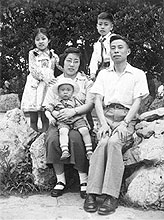 |
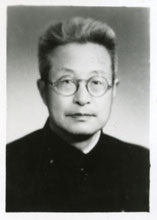 |
| Left: Wenda Gu in his mother's lap
with his father, sister, and brother. 1958. Right:
Wenda Gu's grandfather Gu jiancheng. Launch Gu's family photo album. |
|
Wenda Gu was born in Shanghai, China in 1955. He graduated from Shanghai School of Arts in 1976. In 1981 he received his M.F.A. from China Academy of Arts where he studied under the classical landscape painting master Lu Yanshao and where he taught from 1981 to 1987.
Gu’s parents worked in the banking industry. His grandfather was one of China’s important filmmakers from the 1920’s to the 1940’s. His theater work Lonely Trop is the first modern play with dialogue in China’s theater history. His Shanghai Drama Associates was the longest running theater group in China before 1949.
 |
Wenda Gu and his wife Kathryn Scott cooking in their New York home, 2000. Wenda Gu married Kathryn Scott, a renown interior designer, in 1999. Launch Gu's family photo album. |
Wenda Gu moved to the USA in 1987. He was an associate professor of Studio Art at the University of Minnesota from 1989 to 1990 and received the title of Honorary Minnesotan from the Governor of Minnesota. He has been invited to lecture at various art academies, universities and institutions worldwide.He is a guest artist and adjunct faculty member of Cooper Union in New York. He was a panel member of the International Artists Residence of PS1 Museum in New York in 1995, a panel member of the Student Scholarship Committee of the Chicago Art Institute in 1998, and a jurist for the Macao Arts Festival for the application of United Nations World Heritage. in 2003. Gu was a candidate for an honorary doctorate from the Maine College of Art in 2001.
 |
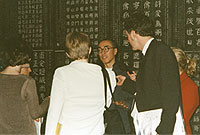 |
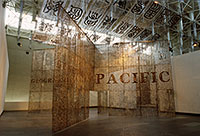
| Top: "Intersections and Translations",
National Gallery of Australia, 2001. Bottom: Wenda
Gu at the opening of "Intersections and Translations" at
National Gallery of Australia, 2001. Launch Gu's family photo album. |
Since 1981, Wenda Gu has participated in numerous international solo and group exhibitions and biennales. He had a survey exhibition for the first time in his artistic career at the National Gallery of Australia in 2001-2002. The countries and regions that have shown his work include China, Hong Kong, Taiwan, Singapore, Japan, Korea, indonesia, Malaysia, Israel, Australia, Germany, Norway, France, Russia, The Netherlands, Italy, Britain, Mexico, Switzerland, Sweden, South Africa, Poland, Brazil, Canada, Turkey and the United States.
Gu is a co-author of Chinese Ink Painting in the Twenty-First Century
published by Shanghai Fine Arts in China. Forthcoming books which will
include Gu’s works include: International Perspectives on Art
and Culture, Documentary Sources in Contemporary Art, 6th
Edition, MIT Press and The New Museum of Contemporary Art, 2004, New York,
USA and Janet Marquardt and Stephen Eskilson: Issues in Visual Culture,
Laurence King Ltd, 2004, London, England.
Gu’s art has been included in such recent art history books as:
Janet Marquardt & Stephen Eskilson, “frames of Reference
- Art, History, and the World”, Mc Graw Hill & Laurence
King Publishing Ltd. London 2004; Peter Osborne: Conceptual Art,
Phaidon Press, London 2002; Glenis Israel, Artwise, John Willey
& Sons Australia Ltd, australia 2003; Edward Lucie-Smith: Art
Tomorrow, London 2003; Laura Hoptman and Thomas Pospiszyl: Primary
Documents: A Sourcebook for Eastern and Central European Art Since the
1950s, The Museum of Modern Art and MIT Press, USA 2003; Marilyn
Stokstad and David Cateforis: Art History, Second Edition, Harry
N. Abrams and Prentice Hall, New York 2001; Michael Kampen O’Riley:
Art Beyond the West, Harry N. Abrams and Prentice Hall, New York
2001; Edward Lucie-Smith: Artoday, Phaidon Press, London 1997; Edward
Lucie-Smith: Visual Arts in the Twentieth Century, Abrams, New
York 1999; Tradition & Innovation-Twentieth Century Chinese Painting,
Hong Kong Museum of Art; Michael Sullivan: Art and Artists of Twentieth
Century China, University of California Press, Berkeley; Caroline
Turner: Tradition & Change-Contemporary Art of Asia and the Pacific,
University of Queensland Press, Australia; Gao Minglu: Contemporary
Art History of China, Shanghai People’s Press and among others.
Wenda Gu had his first survey exhibition at National Gallery of Australia
In 2001 and his first traveling solo exhibition in the US from 2003 to
2004.
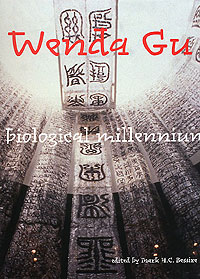 |
| Wenda Gu - Art From Middle Kingdom to Bio logical Millennium, published and distributed by MIT Press, 2003 |
He has received many awards including the Canada Council for Visiting foreign Artists 1987; Wenda Gu - Art From Middle Kingdom to Bio logical Millennium, published and distributed by MIT Press in 2003. This book has won two awards in 2004: the second place of The American Museum Association and the publications design award of The New England Museum Association. The award of Art Document magazine, China 2004; He has been selected as one of ten of China’s most influential visual artists of the twentieth century by the Committee of the Forum of Centennial Art of China.
His art has been widely discussed and reviewed by important international
and national newspapers and magazines. He has been featured in television
and radio programs worldwide such as: BBC in Britain, PBS in America,
CCAC in China, Second National Television Station in Germany, ABC in Australia,
National Television and Radio Station in South Africa, Israel, Sweden,
Japan, Vancouver, Hong Kong, Taiwan, Brazil, France, etc. His art was
included in a cultural documentary film Under Wraps selected
for the Vancouver International Film Festival, Margaret Mead Film &
Video Festival in New York, and nominated as the best cultural documentary
film in the Toronto International Film Festival in 1997.
part 2
 |
 |
 |
|
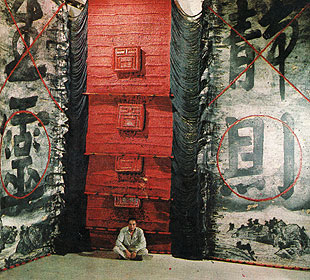
| Left: "wisdom comes from tranquility".
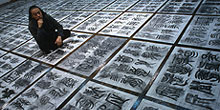
Top Right: Wenda Gu and his invented chinese characters.
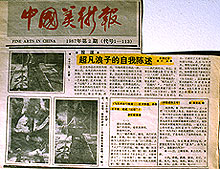
Bottom Right: Reports on Gu's first exhibition. Fine
Arts in China, 1987. Launch Gu's family photo album. |
|
Ever since the Exhibition of Chinese Painting Invitational in Wuhan City in 1984, Gu’s large scale ink paintings, installations and performances have been increasingly exhibited. His first personal exhibition was held by the China National Symposium on Chinese Painting History, organized by China Art Research Institute and Shangxi Artist Association. Although this exhibition was closed by the authorities to the public before the opening, it subsequently reopened only to the professional art circuit. Those works are regarded as the beginning of conceptual ink art in China. Appearing in the major art magazines, Wenda Gu’s work at that moment was “an earthquake” to the traditional ink painting. Those works, using invented, fake, miswritten Chinese characters, and printing style calligraphy become influential. World renowned art historian at UC Berkeley, Dr. Peter Selz, described Wenda Gu as "arguably the most original and authentic artist to emerge in China since the revolution...” (Arts Magazine, Sep. 1989, New York). “At the moment, China’s position in the international art world has yet to be defined. Some artists who have chosen to live abroad, such as Wenda Gu in New York, now hold distinguished positions in the international circuit.” (Lynn Macritchie, Art in America, March 1994, New York). “Wenda Gu... seems to be joining the list of artists whose work is attacked by a large public questioning its status as art and defended by fervent art worlders...” (Roberta Smith, The New York Times, Jan. 19, 1996). Michael Sullivan wrote in his latest book, “these questioning, symbolic works, by violating orthodox doctrine of artistic value, represented a direct challenge to authority...although Wenda Gu was perhaps the most daring and creative serious artist in China between 1985 and 1988.” (Art and Artists of Twentieth Century China, University of California Press, Berkeley, USA)In 1993.
 |
 |
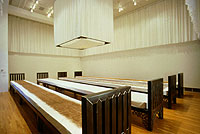 |
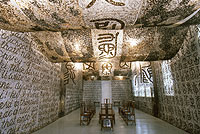
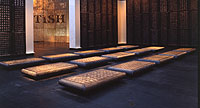
| Top: united nations- china monument: temple of heaven, 1998. Middle: Forest of Stone Steles, NGA 2001. Bottom: oedipus refound #3: enigma beyond joy and sin, 1993 |
Wenda Gu began his fifteen-year ongoing global art project entitled United Nations. Under this conceptually, methodologically, geographically, culturally, ethnically and politically as well as artistically most inclusive and complex project, he has completed his United Nations’ 21 national monuments and sub-projects, and more than one million people from all over the world have contributed their hair to this art project. The chair of The International Art Critics Association, Kim Levin, wrote the following about his United Nations project: “Is this another dawning of the age of Acquarius? A multi-cultural update on the altruistic impulse that over the decades has spawned such artistic events as ‘A Family Of Man’ and ‘We Are The World’? or is it a reexamination of the late 20th century’s intensified and rapidly mutating concepts of ethnicity and nationalism?” (United Nations catalogue, Milan, Italy, 1994). Edward Lucie-Smith explained Wenda Gu’s United Nations project in his new book Visual Arts In the Twentieth Century, “In one sense, Wenda Gu’s project, with its all-embracing ambition, relates to European romanticism - to ideas inherited by the modernists from the culture of the late eighteenth and early nineteenth centuries. In another sense, it is linked, as he himself points out, to ‘growing self-awareness of regionalism and otherness.’ It thus typifies the tensions and deep divisions to be found in the most characteristic artistic expressions of the early 1990s.” (Phaidon Press, London). In Michael K. O’Riley’s new book Art Beyond the West, he explains that the United Nations project “...can be seen as a kind of universal tea house, a place where many cultures can assemble and transcend their national differences. In fact, hundreds of thousands of people from around the world have visited Wenda Gu’s installation in many countries and shared in this experience. It is an intense, ongoing dialogue, not simply between Wenda Gu’s native China and the west, but among many contemporary cultures.” “By violating the traditional system of writing in which the characters carry distinct meanings, Wenda Gu’s work seems to represent a new form of mysticism - with his installations as the temples where the mysteries can be contemplated.” (Prentice Hall & Abrams, New York). “In its ambitious attempt to address in artistic terms the issue of globalism that dominates discussions of contemporary economics, society, and culture, Gu’s work is remarkably timely. Yet, like all important art, it is meant to speak not only to the present but also to the future, which will recognize it as part of the fundamental quest of artists throughout history to extend the boundaries of human perception, feeling, and thought and to express humanity’s deepest wishes, and most powerful dreams. ‘A great ‘utopia’ of the unification of mankind probably can never exist in our reality,’ admits Gu, ‘but it is going to be fully realized in the art world.’” (Art History, Marilyn Stokstad & David Cateforis, Second edition, Chapter International Avant-garde Since 1945, Harry N. Abrams, Inc., Publishers).
Besides his United Nations art project, at the same time in 1993,
Gu also began to plan another 10-year project which he calls
Forest of Stone Steles - Retranslation & Rewriting Tang Poetry.
This project consists of 50 stone steles to be carved with his own contemporary
version of “Tang poems” resulting from a literal translation
of Tang poems from Chinese to English, then a translation by sound of
the Tang poems from English back to Chinese.
 |
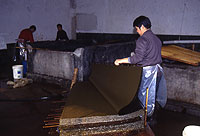 |
| Top: Ink Alchemy, 2003, Bottom: making green tea paper for Tea Alchemy, 2000 |
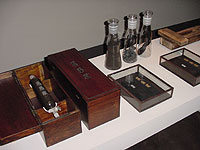
From 1999 to 2001, Gu created many other art projects. Ink Alchemy is a project originating from the famous Shanghai Cao Sugong Ink Factory. It utilizes a genetic product made of powdered Chinese hair used as an installation as well as for ink painting. Tea Alchemy is being created in a rice paper factory in Jing county of Anhui province in China where traditional rice paper has been produced for more than a thousand years. Tea Alchemy uses green tea and traditional rice paper making methods to create green tea paper. Those national treasures of China are given a completely new meaning and life.
They are linked to contemporary biological research and to the genetic
industry. China
Phrase (Gu’s phrase) is a dictionary installation project.
By creating completely new Chinese characters as phrases, each character
is a phrase. It is unprecedented in the history of Chinese language. Yet,
the new Chinese phrases are readable by anybody who can read Chinese.
All these projects, including United Nations and Forest of
Stone Steles are under a grand theme structure: From Middle Kingdom
to Biological Millennium. This is the same theme of his current traveling
solo exhibition in America, and the book on his art.
Gu’s work and contemporary philosophy books of Homi Bhabha, Michel
Foucault, and Gayatri Spivak are to be discussed in American Universities
as the phenomenon of 21st Century new culture. Gu’s United Nations
art project becomes one of the symbolic and important art works of post-modern,
post-colonial internationalism.
Edward Lucie-Smith recently wrote, "Wenda Gu is the most celebrated
of a new generation of avant-garde artists who emerged from China in the
very late 1980s and in the 1990s, as a result of the 'Open Door' policy
that succeeded the chauvinism of the Cultural Revolution...he has made
himself into a fully international figure. In more senses than one, he
is a key figure in the culture of our time." (Catalogue of the grand
opening of the Esplanade in Singapore, 2002). 